A Process is Ready if It is in a State in Which Its Progress Can Continue Quizlet
Latest Process State MCQ Objective Questions
Process State MCQ Question 1:
Consider a computer C1 has n cpus and k processes. Which of the following statements are true?
Answer (Detailed Solution Below)
Option :
The correct answer is option 1, option 2, and option 4.
Concept:
The given data,
The computer c1 has nCPUs and k processes.
In ready state:
In the ready state number of processes are depending on the number of processes available in the computer.
There can be more than one process in the ready state so the maximum number of processes in the ready state is K.
In block state:
In the block state number of processes are depending on the number of processes available in the computer.
There can bemore than one process in the blocked state so t he maximum number of processes in the ready state is K.
In running state:
In the running state number of processes are depending on the number of CPUs in a computer.
The maximum number of processes in the running state is n.
| State | Minimum | Maximum |
| Ready | 0 | k |
| Running | 0 | n |
| Block | 0 | k |
Hence the correct answer isoption 1, option 2, and option 4.
Process State MCQ Question 2:
Which of the following statements is true?
Answer (Detailed Solution Below)
Option 3 : Orders are processed in the sequence they arrive if first come, first served rule sequences the jobs.
The correct answer is option 3.
Concept:
Orders are processed in the sequence they arrive if first come, first served rule sequences the jobs.
First come first serve (FCFS):
First come first serve (FCFS) scheduling algorithm simply schedules the jobs according to their arrival time. The job which comes first in the ready queue will get the CPU first. The lesser the arrival time of the job, the sooner will the job gets the CPU.
- It supports a non-preemptive and pre-emptive scheduling algorithm.
- Jobs are always executed on a first-come, first-serve basis.
- It is easy to implement and use.
- This method is poor in performance, and the general wait time is quite high.
Hence the correct answer is Orders are processed in the sequence they arrive if the first come, first served rule sequences the jobs.
Process State MCQ Question 3:
Information about a process is maintained in a ______.
Answer (Detailed Solution Below)
Option 3 : Process Control Block
 Key Points
Process control block:
It is a data structure that is maintained by the Operating System for every process. A process state is a condition of the process at a specific instant of time. Every process is represented in the operating system by a process control block, which is also called a task control block.
Hence the correct answer isprocess control block.
 Additional Information
- A process control block (PCB) is used to represent a process in the operating system. It is a kernel data structure.
- Each process in the system is represented by a PCB.
- Contents PCB (2 formats) are as depicted below.
| Pointer | Process State | Pointers to various data structure | |||
| Process State | |||||
| Process Number | Process Identification Number | ||||
| Program Counter (PC) | User Identification Number | ||||
| Register | Process Operating Mode | ||||
| Memory Limits | Scheduling Parameters | ||||
| List of Open files | Resources Acquired | ||||
| ..... | Hardware context | Processor Register values PC; stack, Pointers, etc. | |||
| Software context | Signal Info, Open files, Open Sockets, Memory regions. | ||||
- PCB serves as a repository for any information that may vary from process to process.
Process State MCQ Question 4:
The program in the operating system that dose processor management is called _______.
Answer (Detailed Solution Below)
Option 1 : traffic controller
The correct option is (1)
Traffic controller
Concept:-
In a multiprogramming environment, the operating system determines which processes receive processor time and for how long. Process scheduling is the name for this function. For processor management, an operating system performs the following tasks:
- Keep track of the processor and the process's state. The traffic controller is the program that is in charge of this task.
- Allocates the processor (CPU) to a process.
- De-allocates processor when a process is no longer required.
Key Points
- After the scheduler, the dispatcher is finished. It assigns CPU control to the process chosen by the short-term scheduler. The dispatcher assigns CPU to the process when it has been chosen.
- Process scheduling is the action of process management, which involves removing a running process from the CPU and selecting a new process based on a set of rules.
- The new process is brought to the 'Ready State' by a long-term or job scheduler. It regulates the Degree of Multi-programming or the number of processes that are ready at any given time.
Process State MCQ Question 5:
A _________ process is moved to the ready state when its time allocation expires.
Answer (Detailed Solution Below)
Option 3 : Running
Concept:
When a process executes, it passes through different states. These stages may differ in different operating systems, and the names of these states are also not standardized.
In general, a process can have one of the following five states at a time.
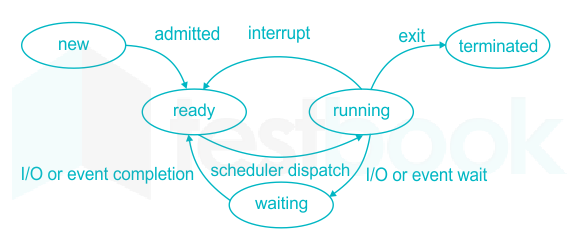
1. Start
- This is the initial state when a process is first started/created.
2. Ready
- The process is waiting to be assigned to a processor. Ready processes are waiting to have the processor allocated to them by the operating system so that they can run. Process may come into this state after Start state or while running it by but interrupted by the scheduler to assign CPU to some other process.
3. Running
- Once the process has been assigned to a processor by the OS scheduler, the process state is set to running and the processor executes its instructions.
- A running process is moved to the ready state when its time allocation expires (quantum time).
- A running process is moved to the terminated state when its execution completed.
4. Waiting
- Process moves into the waiting state if it needs to wait for a resource, such as waiting for user input, or waiting for a file to become available.
5. Terminated or Exit
- Once the process finishes its execution, or it is terminated by the operating system, it is moved to the terminated state where it waits to be removed from main memory.
Top Process State MCQ Objective Questions
Which of the following types of operating systems is non- interactive?
Answer (Detailed Solution Below)
Option 3 : Batch processing operating system
Key Points
Batch Operating System does not interact with the computer directly. There is an operator which takes similar jobs having the same requirement and group them into batches. It is the responsibility of the operator to sort jobs with similar needs.
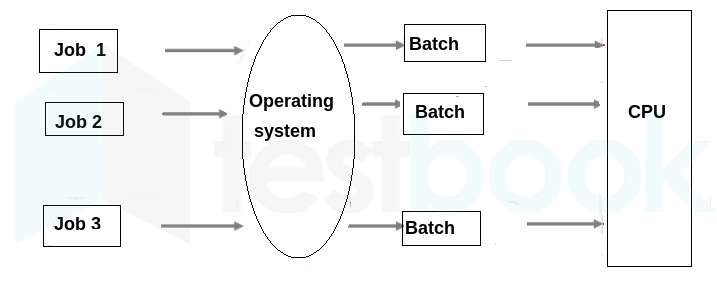
Hence the correct answer is the Batch processing operating system.
Time taken to switch between user and kernel models is _______ the time taken to switch between two processes.
Answer (Detailed Solution Below)
Option 3 : Less than
Concept:
- Switching from kernel to user mode is a very fast operation, OS has to just change single bit at hardware level.
- Switching from one process to another process is time consuming process, first we have to move to kernel mode then we have to save PCB and some registers.
Time taken to switch between user and kernel models is less than the time taken to switch between two processes, so option 3 is the correct answer.
A _________ process is moved to the ready state when its time allocation expires.
Answer (Detailed Solution Below)
Option 3 : Running
Concept:
When a process executes, it passes through different states. These stages may differ in different operating systems, and the names of these states are also not standardized.
In general, a process can have one of the following five states at a time.
1. Start
- This is the initial state when a process is first started/created.
2. Ready
- The process is waiting to be assigned to a processor. Ready processes are waiting to have the processor allocated to them by the operating system so that they can run. Process may come into this state after Start state or while running it by but interrupted by the scheduler to assign CPU to some other process.
3. Running
- Once the process has been assigned to a processor by the OS scheduler, the process state is set to running and the processor executes its instructions.
- A running process is moved to the ready state when its time allocation expires (quantum time).
- A running process is moved to the terminated state when its execution completed.
4. Waiting
- Process moves into the waiting state if it needs to wait for a resource, such as waiting for user input, or waiting for a file to become available.
5. Terminated or Exit
- Once the process finishes its execution, or it is terminated by the operating system, it is moved to the terminated state where it waits to be removed from main memory.
What name is given to a program in execution?
Answer (Detailed Solution Below)
Option 1 : Process
The correct answer is option 1.
Key Points A process is the instance of a computer program that is being executed. It contains the program code and its activity. A process may be made up of multiple threads of execution that execute instructions concurrently.
Program in execution is called process. The process is an active entity.
Hence the correct answer is process.
Additional Information
- A program is a system activity that uses a set of instructions to perform a designated task. It is considered a passive entity as it resides on secondary memory.
- A mutex is a binary variable whose purpose is to provide a locking mechanism. It is used to provide mutual exclusion to a section of code, which means only one process can work on a particular code section at a time.
Which of the following is not a valid process state?
Answer (Detailed Solution Below)
Option 2 : Hold
The hold is not a valid process state.
Explanation:-
Process state:- As a process executes, it changes state. The state of a process is defined in part by the current activity of that process. Each process may be in one of the following states:-
- New:- The process is being created.
- Running:- Instructions are being executed.
- Ready:- The process is waiting to be assigned to a processor.
- Terminated:- The process has finished execution.
 Important Points
- The states that they represent are found on all systems, however. The certain operating system also more finely delineates process states.
- It is important to realize that only one process can be running on any processor at any instant.
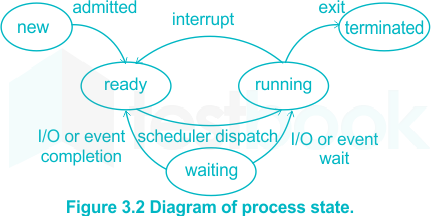
Consider the following statements about process state transitions for a system using preemptive scheduling.
I. A running process can move to ready state.
II. A ready process can move to running state.
III. A blocked process can move to running state.
IV. A blocked process can move to ready state.
Which of the above statements are TRUE?
Answer (Detailed Solution Below)
Option 3 : I, II, and IV only
A process state diagram for a pre-emptive scheduling is:
Statement I: TRUE
A process can move from running state to ready state on interrupt or when priority expires, that is, when it is pre-empted.
Statement II: TRUE
A ready process moves to running process when it is dispatched.
Statement III: FALSE
A blocked process that is in waiting state can never move directly to running state. It must go to ready queue first.
Statement IV: TRUE.
A blocked or waiting process can move to ready state.
Important Point:
The transition from running to ready state is possible only in pre-emptive scheduling. It cannot happen in non pre-emptive scheduling.
With respect to operating systems, which of the following is NOT a valid process state?
Answer (Detailed Solution Below)
Option 4 : Starving
Key Points
Process States:
Each process goes through different states in its life cycle,
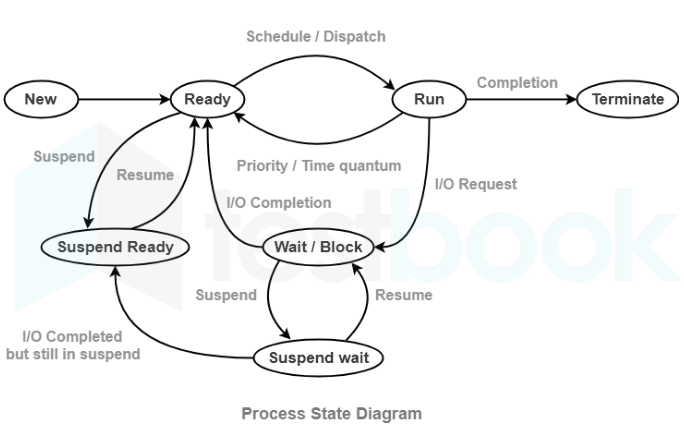
- New (Create) – In this step, the process is about to be created but not yet created, it is the program that is present in secondary memory.
- Ready – New -> Ready to run. After the creation of a process, the process enters the ready state. i.e. the process is loaded into the main memory
- Run – The process is chosen by CPU for execution and the instructions within the process are executed by any one of the available CPU cores.
- Blocked or wait – Whenever the process requests access to I/O or needs input from the user or needs access to a critical region it enters the blocked or wait state.
- Terminated or completed – Process is killed as well as PCB is deleted.
Hence the correct answer is Starving.
A process waiting to be assigned to a processor is considered to be in ___ state.
Answer (Detailed Solution Below)
Option 2 : ready
Whenever a process executes, it goes through several phases or states. These states have their functions.
New – in this state, process is being created
Running – instructions are being executed
Waiting: the process is waiting for some event to occur such as i/o completion
Ready – The process is waiting to be assigned to a processor
Terminated – The process has finished execution.
If a computer system completes n processes in t seconds, then its throughput is _______ processes per second during that interval
Answer (Detailed Solution Below)
Option 3 : n/t
Key Points
Concept:
Throughput:
Throughput is the amount of work completed in a unit of time. In other words, throughput is the processes executed to the number of jobs completed in a unit of time. The scheduling algorithm must look to maximize the number of jobs processed per time unit.
Throughput =μ =\({{number \space of \space process} \over shedule \space length }= {N \over L}\)
Explanation:
Given that,
the number of processes= n process
Completion time of all process (or) schedule length= t seconds
Throughput= n/t processes per second.
Hence the correct answer is n/t.
In which of the following state, the process is waiting for processor ?
Answer (Detailed Solution Below)
Option 3 : Ready
Process state diagram.
Scheduling is performed from when the process is taken from the ready state on to the running state.
In ready state, the process is waiting for the processor.
The program in the operating system that dose processor management is called _______.
Answer (Detailed Solution Below)
Option 1 : traffic controller
The correct option is (1)
Traffic controller
Concept:-
In a multiprogramming environment, the operating system determines which processes receive processor time and for how long. Process scheduling is the name for this function. For processor management, an operating system performs the following tasks:
- Keep track of the processor and the process's state. The traffic controller is the program that is in charge of this task.
- Allocates the processor (CPU) to a process.
- De-allocates processor when a process is no longer required.
Key Points
- After the scheduler, the dispatcher is finished. It assigns CPU control to the process chosen by the short-term scheduler. The dispatcher assigns CPU to the process when it has been chosen.
- Process scheduling is the action of process management, which involves removing a running process from the CPU and selecting a new process based on a set of rules.
- The new process is brought to the 'Ready State' by a long-term or job scheduler. It regulates the Degree of Multi-programming or the number of processes that are ready at any given time.
Which of the following states of process in operating system is defined incorrectly?
Answer (Detailed Solution Below)
Option 3 : Waiting: process is waiting to be assigned to a processor
The correct answer is option 3.
Concept:
From new to termination, the process state goes through five states that are required.
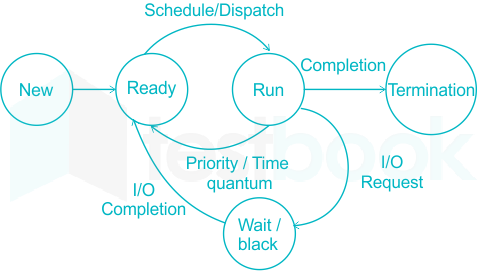
New:
A new process is a program that will be loaded into the main memory by the operating system.
Ready:
When a process is created, it immediately goes into the ready state, where it waits for the CPU to be assigned to it.
Run:
The OS will choose one of the processes from the ready state based on the scheduling mechanism.
Completion or termination:
A process enters the termination state after it has completed its execution. The process's context will be removed as well, and the process will be terminated by the operating system.
Block or wait:
In a wait or block state, Depending on the scheduling method or the process's inherent behavior, a process can transition from the Running state to the Block or Wait for the state.
In the Waiting state, thesituation in which a computer program or processor is waiting for the completion of some event before resuming activity. And theprocess is not assigned to a processor.
Hence the correct answer is Waiting: the process is waiting to be assigned to a processor.
Consider the following statements regarding life time of any normally terminating process in an operating system.
(I) The process must be in RUNNING state at least once during its execution.
(II) The process must be in RUNNING state at least twice during its execution.
(III) The process must be in WAITING state at least once during its execution.
(IV) The process must be in READY state at least once during its execution.
Which of the above statements are correct?
Answer (Detailed Solution Below)
Option 2 : I only
The correct answer is option 2.
Concept:
Option 1:The process must be in a RUNNING state at least once during its execution.
True, In the running state, the CPU selects the process for execution, and the instructions within the process are performed by any available CPU core. The process has to be in running state at least once during its execution.
Option 2:The process must be in a RUNNING state at least twice during its execution.
False, The process has to be in running state at least once during its execution. If the process has two running states then there is no use visiting a second time in the second running state because it already executed the process execution.
Option 3: The process must be in a WAITING state at least once during its execution.
False, A wait state is a situation in which a computer program or processor is waiting for the completion of some event before resuming activity. A program or process in a wait state is inactive for the duration of the wait state. If a CPU has a limited number of processes with well-formed arrival times then there is no use of waiting states.
Option 4: The process must be in a READY state at least once during its execution.
False, there is no use of a ready state because after a process is created, it enters the running state, which means it gets loaded into the main memory after the CPU selects the process for execution, and the instructions within the process are executed by any available CPU core.
Hence the correct answer is I only.
blankenshipnoult1990.blogspot.com
Source: https://testbook.com/objective-questions/mcq-on-process-state--5eea6a1539140f30f369f338
Belum ada Komentar untuk "A Process is Ready if It is in a State in Which Its Progress Can Continue Quizlet"
Posting Komentar